


Biggest Bang
- By Alexe Helmke
- August 9, 2012
- Comments Off on Biggest Bang
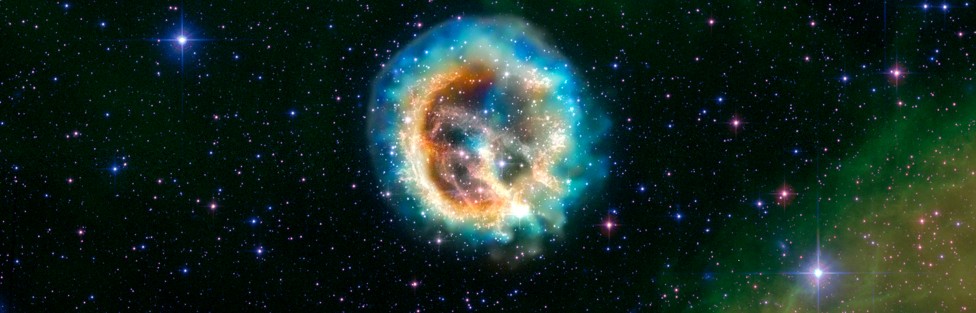
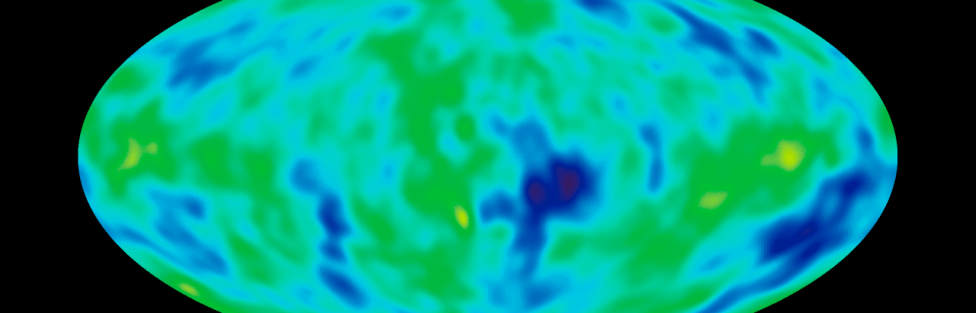
Welcome to the -EST blog! Here we’ll chat about some of the awesome astronomical superlatives that exist in our universe – biggest, smallest, brightest, coldest, densest, and whatever else we come up with. As this is my first -EST blog, I thought it would make sense to start with something … Continue Reading →
Anatomy of an Exosolar System
- By Jillian Brown
- August 3, 2012
- Comments Off on Anatomy of an Exosolar System
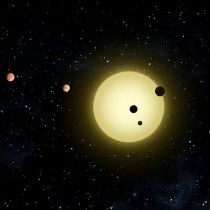
A good chunk of the exoplanets that we’ve detected so far are huge, Jupiter-sized and larger. A lot of them are orbiting their stars at very short distances – it might seem strange to think that planets bigger than Jupiter are orbiting their stars closer than Mercury orbits the Sun, … Continue Reading →
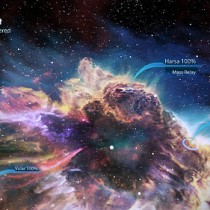
Exploring the Galaxy with Mass Effect 3
- By Sara Mitchell
- July 31, 2012
- 1 Comment
The fictional Kite’s Nest from Mass Effect 3 Image provided by EA/BioWare The first time I caught a glimpse of the astronomical imagery in the Mass Effect video games, I was blown away by how realistic everything looked. While the plot of the games is solidly science fiction, the setting … Continue Reading →
Awesomeness Round-Up – 7/27/2012
- By Alexe Helmke
- July 27, 2012
- Comments Off on Awesomeness Round-Up – 7/27/2012
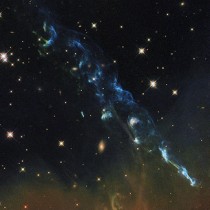
Credit: NASA, ESA, and the Hubble Heritage Team (STScI/AURA) Hubble captured this wonderful image that looks very much like an outer space firework explosion. Herbig-Haro 110 is a geyser of hot gas being blown away from a newborn star that ricochets off the dense core of a cloud of molecular … Continue Reading →
Exoplanets, Tech, and Space Travel
- By Jillian Brown
- July 24, 2012
- 3 Comments
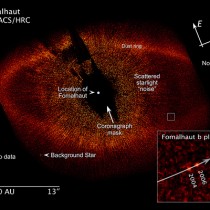
Fomalhaut + Fomalhaut b; courtesy of NASA, ESA, UC Berkeley, NASA GSFC, Lawrence Livermore National Laboratory, and NASA JPL-Caltech) For a lot of people, exoplanets are some of the most exciting discoveries in current astronomy. The first exoplanets were detected in 1992 orbiting the pulsar PSR B1257+12, all three of … Continue Reading →
Want to get a postcard from Blueshift?
- By Maggie Masetti
- July 20, 2012
- 2 Comments
Guess what! We’ve turned 5! NASA Blueshift released its first podcast in 2007 (we’d like to think that our podcasts have vastly improved since those early episodes), and we’ve steadily expanded to blogging, tweeting, and keeping up with social media to find the best ways to bring the Universe closer … Continue Reading →
Try It At Home: Build-It-Yourself: Satellite launches!
- By Maggie Masetti
- July 18, 2012
- Comments Off on Try It At Home: Build-It-Yourself: Satellite launches!
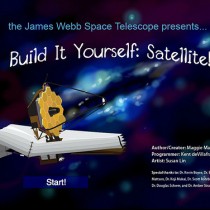
I wanted to thank all you Blueshift readers (especially a few of our Facebook followers) who were really helpful at offering me feedback for my new game. We’ve made a bunch of changes and released the final result! If you played an earlier version, please give the latest one a … Continue Reading →
The Life of a Scientist: Traveling to ACM 2012, Niigata, Japan
- By Christina Richey
- July 12, 2012
- Comments Off on The Life of a Scientist: Traveling to ACM 2012, Niigata, Japan
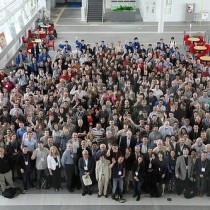
The 2012 Asteroids, Comets, Meteors (ACM) Conference, was held mid-May in Niigata, Japan. The conference brought together approximately 400 scientists from over 30 countries to present observational, experimental, and theoretical results on small bodies (see the group photo below). I presented my experimental work on metal-silicate dust grain analogs and … Continue Reading →
Ring Around the Moon
- By Maggie Masetti
- July 10, 2012
- Comments Off on Ring Around the Moon
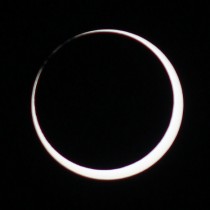
It all started when my friend Craig mentioned that there was an upcoming annular eclipse that would be visible from the US. And that maybe we should go to Portland to visit it. Or better yet, Arizona, where the skies would be much more likely to be clear! Solar eclipses … Continue Reading →
Awesomeness Round-Up – 7/6/2012
- By Alexe Helmke
- July 6, 2012
- Comments Off on Awesomeness Round-Up – 7/6/2012
Credit: NASA/JPL-Caltech Voyager is soon to be the first man-made object to leave the solar system. Data from NASA’s Voyager 1 spacecraft indicate that this deep space explorer has entered a region in space where the number of charged particles from beyond our solar system has significantly increased. This could … Continue Reading →