
JWST @ SXSW, part 2
- By Maggie Masetti
- March 9, 2013
- Comments Off on JWST @ SXSW, part 2
Despite posting my blog pretty late last night, there are still a few things I want to share with you from Friday at South by Southwest. The NASA tent was busy til 10:30 PM last night – and would have been still going til midnight if the weather had cooperated … Continue Reading →
JWST @ SXSW
- By Maggie Masetti
- March 8, 2013
- Comments Off on JWST @ SXSW
The big event is here – South by Southwest. It’s a giant music, film, and tech festival that runs for 2 weeks in Austin, TX. And this year, NASA is at SXSW! Right next to the Interactive Festival, is a big NASA tent and… the full-scale model of the James … Continue Reading →

JWST is coming to South by Southwest!
- By Maggie Masetti
- March 4, 2013
- Comments Off on JWST is coming to South by Southwest!
That’s right! During the South by Southwest Gaming Expo from March 8 to 10, 2013, Austin will be home to the full-scale model of the James Webb Space Telescope. The model does not often make appearances, and as it is the length of a tennis court and four stories tall, … Continue Reading →
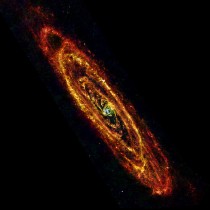
Andromeda in the Infrared
- By Maggie Masetti
- February 11, 2013
- Comments Off on Andromeda in the Infrared
Check out this gorgeous new image of the Andromeda Galaxy taken by the European Space Agency’s Herschel space observatory in the far-infrared. This new view shows cool lanes of forming stars in fine detail. Credit: ESA The news release says, Sensitive to the far-infrared light from cool dust mixed in … Continue Reading →
Teaming Up with Hubble to Create Beauty
- By Maggie Masetti
- February 7, 2013
- Comments Off on Teaming Up with Hubble to Create Beauty
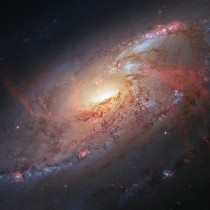
Capturing the beauty of this galaxy took a team of people – and to understand the galaxy takes a team of missions. This gorgeous image of galaxy M106 was created by renowned astro-photographer Robert Gendler, who retrieved archival Hubble images to assemble a mosaic of the center of the galaxy. … Continue Reading →
A Grand Spiral
- By Maggie Masetti
- February 5, 2013
- Comments Off on A Grand Spiral
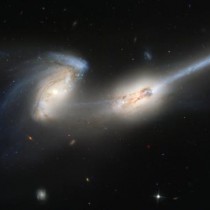
The ultraviolet GALEX satellite just revealed the largest known spiral galaxy! NGC 6872 (a barred spiral) is 522,000 light-years across from the tip of one outstretched arm to the tip of the other, which makes it about 5 times the size of our home galaxy, the Milky Way! We recently … Continue Reading →
Shiny: a Look at Astro-H Flight Hardware
- By Maggie Masetti
- January 9, 2013
- Comments Off on Shiny: a Look at Astro-H Flight Hardware
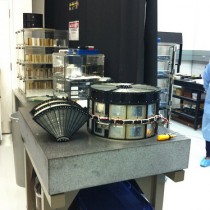
Here’s some brand new photos from one of the missions we are working on here at the Astrophysics Science Division – Astro-H! Astro-H is an orbiting X-ray astronomy observatory being developed by the Japanese Aerospace Exploration Agency (JAXA). NASA and JAXA have teamed up to develop a high resolution “Soft … Continue Reading →
Lighthouses in Space
- By Maggie Masetti
- December 28, 2012
- 1 Comment
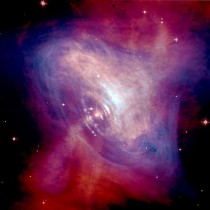
Since pulsars are something we study here in the Astrophysics Science Division at NASA, and we know it’s a topic people are always curious about, we interviewed astrophysicist Dr. Tod Strohmayer to ask him all about them. Blueshift: What’s a pulsar? Would you say they look sort of like lighthouses … Continue Reading →
Podcast: Hubble’s Scientific Successor
- By Maggie Masetti
- December 20, 2012
- Comments Off on Podcast: Hubble’s Scientific Successor
As you might imagine, the James Webb Space Telescope is a pretty big deal here at NASA Goddard, because much of it is being assembled here. You’ve seen our posts with image of its primary mirror segments arriving, and glimpses of other flight hardware in our cleanroom. As a companion … Continue Reading →
Farthest
- By Maggie Masetti
- December 18, 2012
- Comments Off on Farthest
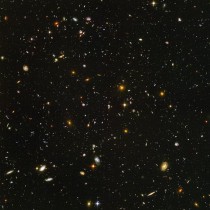
I was inspired to pick up where Alexe left off with her “est” blogs, and write about “Farthest,” because of some recent, cool, astronomical news. There was recently excitement over a Hubble Space Telescope discovery of seven primitive galaxies located over 13 billion light years away from us. The results … Continue Reading →