
 |
Goddard Space
Flight Center NASA > GSFC > Astrophysics Science Division > IXO |
|

At their cores, neutron stars harbor the highest matter densities in the Universe, up to several times the densities in atomic nuclei. The behavior of matter under such conditions is governed by Quantum Chromodynamics (QCD), and the close study of the properties of neutron stars offers the unique opportunity to test and explore the richness of QCD in a regime that is beyond the reach of terrestrial experiments. While laboratory experiments (RHIC, LHC) explore the high-temperature, low-density regime, astrophysical studies will probe the opposite, low-temperature, high-density regime, where a multitude of novel phenomena associated with QCD phase transitions may take place. This unique leverage provided by astrophysics is illustrated in the figure below, which shows the temperature/chemical potential phase plane of matter. Observations of X-ray emission from neutron stars with IXO have the potential of providing an experimental determination of the "Cold Equation of State" of matter through measurement of the fundamental mass-radius relation of neutron stars.
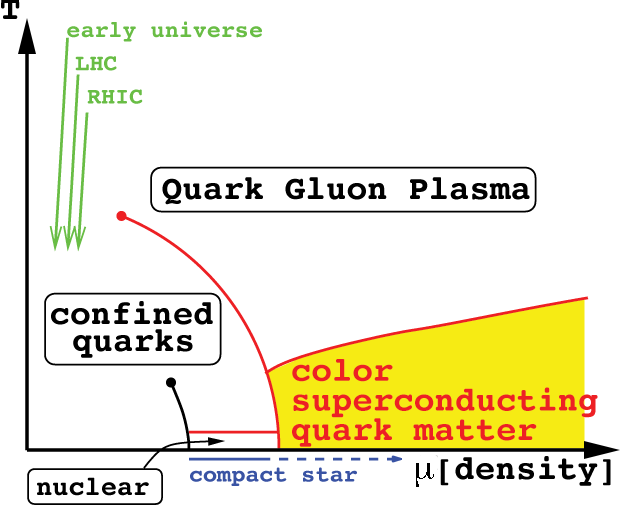
The temperature/chemical potential phase plane of matter: Measurements with IXO will probe the low temperature/high density part of the fundamental phase plane of matter, probing the content of QCD under conditions that are complementary to those probed at terrestrial experiments.
(Click image for a larger view.)
Accurate masses for a number of neutron stars have been obtained from observations of radio pulsars in binary systems, but essentially nothing precise is known about the radii of neutron stars other than that they should be of order 10 km. X-ray observations allow the study of photospheric emission from neutron stars, which will in turn allow the measurement of fundamental stellar parameters using tested concepts of astrophysical stellar spectroscopy in a novel context.
Accreting neutron stars in binary systems provide several unique opportunities to probe the structure of neutron stars, because continuing accretion ensures high photospheric metal abundances with the attendant atomic absorption spectra, while the occurrence of X-ray bursts (periodic thermonuclear explosions on the surface) produces high surface flux. During bursts, the spin rate of the neutron star can be observed directly (so called "burst oscillations''). In addition, old accreting neutron stars will have gained enough mass to probe the mass-radius relation in a mass range different from that of the young radio pulsars. Alternatively, nonaccreting neutron stars for which a distance is known, provide opportunities for measuring fundamental stellar properties from just the shape of their continuum spectrum. The determination of the masses and radii for radio pulsar neutron stars (from the spin precession in relativistic binaries) will probably be unable to break the degeneracy between baryonic and exotic stars in the mass-radius diagram near 1.4-1.8 Msun / 9-11 km, and therefore observations of high-mass neutron stars will be essential (see figure above; Lattimer & Prakash 2001, 2007). The science requirement for IXO is to determine the radii and mass of several neutron stars to within several percent, providing strong constraints on the Neutron Star Equation of State.
Photons will be redshifted while escaping from a neutron star's powerful gravitational field, and if the redshift, z, can be measured, it will provide a direct measure of the stellar mass to radius ratio, since z depends on the ratio GM/c2R. Cottam, Paerels & Mendez (2002) found evidence for narrow, redshifted Fe absorption lines in co-added spectra of 28 X-ray bursts from the Low Mass X-ray Binary (LMXB) EXO 0748-676 with the XMM-Newton RGS. Their proposed identifications for these lines with the H-α analog transitions of Fe XXVI and XXV implies a surface redshift of z = 0.35 that is consistent with most modern EOS.
Detailed line profile spectroscopy can now be used to constrain other combinations of mass and radius. The requirement for detecting and characterizing the absorption line spectrum can be stated (from explicit models for the atmosphere and the emergent photospheric spectrum) as: detection of approximately 20 eV equivalent width absorption lines at high significance (independent of rotational Doppler broadening). At this point the redshift measurement will be trivial. Equivalent width measurements are in principle sufficient for measurement of the pressure broadening (which scales with surface gravity and hence GM/R2), while other techniques depend on resolving the line profile to measure the Doppler shifts and knowing the stellar spin period, to measure the stellar radius. A variety of general relativistic effects will also produce observable distortions of the line profiles.
Scaling from the XMM-Newton/RGS observations of EXO0748-676, which has a 45 Hz spin period (Villareal and Strohmayer 2004), 3 X-ray bursts will provide the sensitivity to detect the Fe XXVI Balmer spectrum at 5 σ significance, which will require of order 30 ksec exposure (depending on the burst rate; see figure below for a sample spectrum). With 1 ksec effective burst exposure time, one can detect even a severely spin-broadened absorption line at this equivalent width (at 500 Hz spin period, 8.6 σ significance against a continuum-only model). A candidate source list of X-ray bursters that are candidate targets for photospheric burst spectroscopy at an exposure time of 100 ksec or less comprises 13 objects. Note that there is considerable redundancy if both the equivalent width and the detailed profile shape of a set of absorption lines have been measured: pressure broadening and rotational broadening provide independent constraints. Since the requirements on spectral resolving power for this experiment are modest (the sensitivity depends mostly on the ability to detect low-contrast, resolved features on a noisy continuum), degradation of the resolving power of the microcalorimeters at the high count rates expected during X-ray bursts is not a major concern. Alternatively, at very high fluxes, observations with the grating spectrometer become feasible, and these preserve the full spectroscopic resolution.
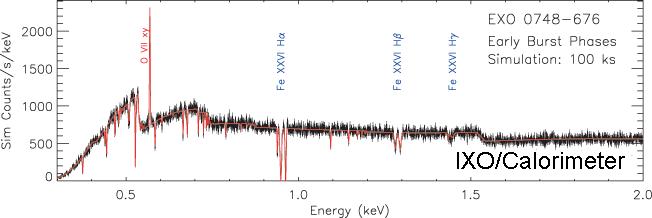
Simulated IXO Spectrum of Neutron Star Thermonuclear X-ray Bursts: The simulated spectrum of the early phases of the X-ray bursts from the accreting neutron star EXO 0748-676 using IXO (100 ks observation yields 1 ks of burst time). The blue labeled lines are gravitationally redshifted absorption lines from the neutron star atmosphere. The remaining spectral structure originates in the circumstellar material. The model was developed using the XMM-Newton data and theoretical calculations for the absorption line structure.
(Click image for larger view.)

 Top
Top