
HMC-97-108
To: I. Steve Smith
From: Henry M. Cathey, Jr.
Date: April 2, 1997
Subject: Initial Engineering Estimate of the Environmental Conditions for an Extended Duration Balloon Flight
There are several factors that significantly effect the balloons performance. The environmental influences were listed in memo HMC-96-122, "Documenting Requested Thermal Analysis Efforts" dated November 8, 1996. The environmental influences are the same as those listed in the section Thermal Analysis Requirements. The following is an excerpt from that memo and lists the required information:
- Exposure Environment
- Solar Constant
- Albedo
- Earth IR
- Earth Temperature
- Cloud Temperature
- Cloud Cover Percentage
The characteristics of the balloon that have to be considered such as geometry, construction, material properties, and the like are not addressed here. They are addressed in the aforementioned memo. This memo deals only with the external exposure environment. It is recognized that the absorptivity and emissivity of the balloon or the payload surfaces can also influence the decision of just what are the worst case environmental exposure conditions.
The exposure environment is variable throughout the year. To develop a worst case set of criteria, one could take the extremes for each of the individual variables and form a "hot" and "cold" worst case exposure. This should be sufficient for a first order analysis. The following is a brief discussion of each factor and the initial recommended environmental conditions. Most of this material has been covered in memos that I have written during the past eight months.
It should be highlighted that the values presented in this document are initial engineering estimates based on past balloon flight experience. It is strongly recommended that the final "standard" set of environmental bounding conditions be based on statistical interpretation of existing data. These sets of bounding conditions, especially for the albedo and earth IR, should be a function of latitude and time of year. Again, the values presented in this memo are representative of the worst cases expected to be found in the existing data and/or literature, but should only be considered as initial engineering estimates pending statistical analyses.
Solar Constant
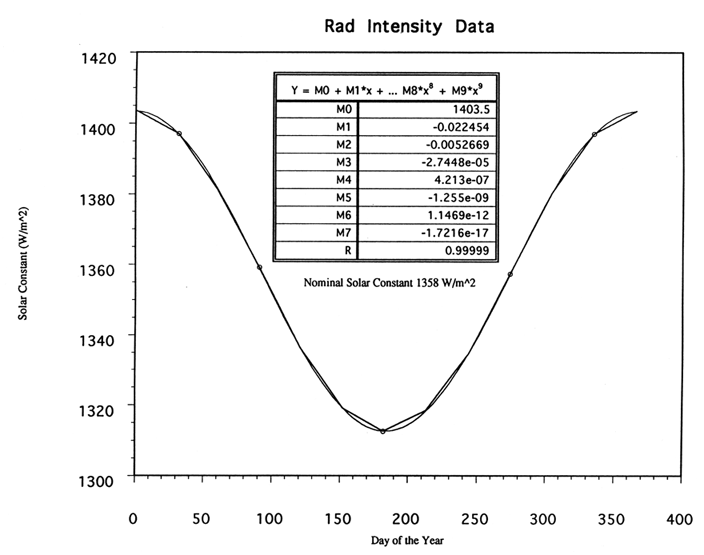
The solar constant varies by just over 3% from a nominal value during the year. Attached is a table and plot showing this variation of the "relative intensity of radiation on the first of each month". This variation throughout the year is known. The solar constant (nominal value) chosen as the baseline for this variation is subject to discussion. Different reference sources choose different values for the solar constant based on the original source of the data. The value of the solar constant is also refined as more research is completed. The variations in the value of the normally chosen solar constants are minimal, and on the order of 1% to 2%. This essentially makes the discussion a moot point, leading one to the decision to choose a value and stick to it, or ignore the small differences.
I have previously chosen the values of 1351 W/m2 and 1358 W/m2 as a nominal values. Also attached is a curve showing the solar radiation variation as a function of day of the year and a curve fit for the data. Implicit with the assumption of a solar constant is that there is no attenuation from the atmosphere at the float altitude. If one were concerned about more accurately characterizing the solar input, one could increase/decrease the solar constant by several percent over/under the presented annual variation and attempt to account for the approximately 1% of the atmosphere that will attenuate the source. Unexpected solar events, such as solar flares, are also not addressed.
My opinion is to pick a solar constant, know the "inherent errors", and move on.
Albedo
Albedos vary across the entire surface of the planet and are variable due to time of the year. There is a wealth of data concerning albedo values for most land, water, cloud, ice, and vegetation types. A detailed survey of albedos as a function of day of year, latitude, and longitude could be compiled. This would provide interesting information for flight planning and in parametric performance analyses. This is not however required for the initial bounding of the problem. One could assume minimum and maximum albedos, for example 0.1 and 0.9. This is simplistic, but should be adequate for our initial purposes.
A better approach for future analyses that is not as detailed as a full planet survey as suggested above, would be to do a survey of the different underflight terrains and bound values for each. Water would have high and low albedo values, ice/snow would have high and low albedo values, etc. This does not give an explicit set of values for a true performance analysis, but a relative set for review purposes.
It should be noted that the global averaged albedo data may not provide sufficient information for the actual albedo "seen" by the balloon. The balloon is much more sensitive to conditions directly below the balloon with potentially a higher "granularity" in data values required. This is discussed below in the Zone of Influence.
For an initial estimate, one needs to consider the latitude of the projected flight. A south polar flight, based on previous balloon flights, will have a very high albedo. In this case 0.9 is assumed. An equatorial flight albedo, from a general review of the data published (orbit averaged), shows the maximum albedos on the order of 0.45. For an equatorial flight the maximum albedo is chosen to be 0.55. This is nothing more than an engineering estimate. It should be noted that a change in albedo of 0.1 for an equatorial flight where there is very high earth flux, the balloon's steady state temperature will change less than 2 degrees C, thus making the balloon relatively insensitive to changes in albedo.
Earth IR
The earth IR contribution is not a straight forward simple problem. It is a function of the earth temperature, cloud temperature, and cloud cover percentage. It has been seen that relatively small features under the balloon, such as a squall line of clouds or a blacktop road, will directly affect the balloons performance. The IR input is actually more coupled to the planet's surface temperature, cloud top temperature, or a combination of both. The obvious choice is to choose the maximum and minimum temperatures as a function of the surface temperatures seen below the balloon.
Again an approach to determine realistic values for the earth IR contribution were detailed previously. It should be noted that the global averaged IR data will again not provide sufficient informatdon for the actual IR "seen" by the balloon. The balloon is much more sensitive to conditions directly below the balloon with again potentially a higher "granularity" in data values required. This is again discussed below in the Zone of Influence. The values that I have used for my thermal analyses of the balloon structure, which are detailed in memo HMC-96-124, "Status and Results of Recent Thermal Analysis Efforts, Albedo and Earth Flux Loading" dated December 5, 1996, are as follows:
| Planet Temperature (K) | Planet Power (W/m2) | |
| 200 | 90.7040 | |
| 210 | 110.2513 | |
| 220 | 132.7997 | |
| 240 | 188.0838 | |
| 254.5 | 237.8050 | |
| 260 | 259.0597 | |
| 280 | 348.4485 | |
| 300 | 459.1890 | |
| 320 | 594.4377 |
Several different sources of earth flux or earth temperature data were researched to determine appropriate values for these analyses. These are presented in the attached sheet, "Earth Flux & Temps". These values above show a significantly larger variation than the standard zonal averages usually presented and used for space flight analyses. This larger variation is again due to the low altitudes and the higher coupling to the planets surface. Local hot or cold spots can have a significant effect on the balloons performance. The choice of the above values are merely used to bracket the possible values.
The planet temperature of 200 K represents a high cold cloud deck at the Troposphere. The value of -70 deg C to -80 deg C has been traditionally used in ballooning as the coldest earth/cloud temperatures that a balloon has seen. This needs to be confirmed from measured sources, but should serve as an initial cold reference point. The planet temperature of 320 K represents a hot desert surface temperature. Again, this needs to be confirmed from measured sources, but should serve as an initial hot reference point. In a south polar flight the earth IR can not be as high due to local surface temperatures. A value of 280 K was chosen for this case.
Zone of Influence
The balloon at float is highly influenced by the earth immediately below. This relates directly to the earth's albedo and emitted energy. The cloud cover, including the types of clouds, also highly influences the balloon. The "Zone of Influence" below the balloon needs to be determined. The Zone of Influence can be pictured as a concentric set of areas (bulls eye) below the balloon that contribute to the balloons loading. The area directly below is assumed to contribute the most with decreasing influence as one moves outward from the center. The statistical areas of these regions and the influence of each needs to be determined.
The requirements and approach to determine this were presented in several memos dated August 12, 1996, October 2, 1996, and December 5, 1996. This was not a pressing issue at that time. It appears that it is now an appropriate time to pursue this effort. This can be done from a theoretical standpoint with our existing automated thermal analysis tools.
Initial Assumptions
The balloon's daytime maximum temperature is reached in the time frame when the sun is at its zenith. Using steady state conditions as the initial estimated conditions, I would choose the following values for each of the parameters based on the information above and detailed in my memos to you over the past eight months:
| Solar Constant | 1358 W/m2 (nominal) | |
| 1312 W/m2 (minimum) | ||
| 1404 W/m2 (maximum) | ||
| Albedo | 0.1 (minimum) | |
| 0.9 (maximum) | ||
| Earth Flux | 90.7040 W/m2 (minimum, representing a 200 K planet temperature) | |
| 594.4377 W/m2 (maximum, representing a 320 K planet temperature) | ||
The above environmental conditions lead to the following initial worst case flight conditions:
'"Hot" Case, Polar - representing clear sky Antarctic overflight
| Solar Constant | 1404 W/m2 | |
| Albedo | 0.9 | |
| Earth Flux | 348 W/m2 (Earth temperature at 280 K, just above freezing) | |
"Hot" Case, Equatorial - representing clear sky hot region overflight
| Solar Constant | 1404 W/m2 | |
| Albedo | 0.55 | |
| Earth Flux | 594 W/m2 | |
"Cold" Case - representing night time flight over cold (-73 deg C) cloud deck
| Solar Constant | 0 W/m2 | |
| Albedo | N/A | |
| Earth Flux | 91 W/m2 | |
I would further suggest that all members of the BPB R&D team review the above "worst cases" before dissemination of the information.
 [an error occurred while processing this directive]