
Table of Contents
- Purpose Of This Report
- Background, Goal, And Organization
- Summary Of Current Information
- Technical Challenges
- Other Issues-Beyond The Scope Of This Study But Impacting The Program
- Summary List Of Technologies Under Consideration
- Next steps
Purpose
The purpose of this interim report is to:
- document requirements information,
- identify technical challenges of the Ultra-Long Duration Balloon Program,
- provide input to the demonstration program at Wallops and
- provide information to non-balloon scientists and engineers regarding differences between balloon and space missions and potential opportunities for science.
Background, Goal and Organization
The ULDB Program study was initiated by NASA Headquarters
in June 1996. There are three distinct but related projects currently
underway. They are:
- ULDB (³100 day flight) Study: This is a science feasibility study to evaluate whether science goals can be met and to identify technical challenges to satisfy science needs.
- The Demonstration Program: This is the initial ~100 day balloon flight demonstrating the capability of superpressure balloons and the type of science that can be accomplished. This will also show the technology available to successfully undertake such missions in the future.
- Mission/Program: An Ultra-Long Duration Balloon Program will be the result of a successful demonstration program.
Goal
The goal of the ultra-long balloon program study is to create a ³100 day balloon model which is technically feasible and within program cost constraints while maintaining existing balloon program. This program will identify commercial and existing spacecraft technologies and practices to improve performance and contain costs.
The ULDB program is significantly different from the current balloon program in that the expected science return is significantly greater than current balloon missions. In other words, it is more than simply extending current experiments over a longer time period. This program also expects to use technologies currently available in the spacecraft missions and commercial arenas to improve performance while containing costs. Organization Of The Study Team
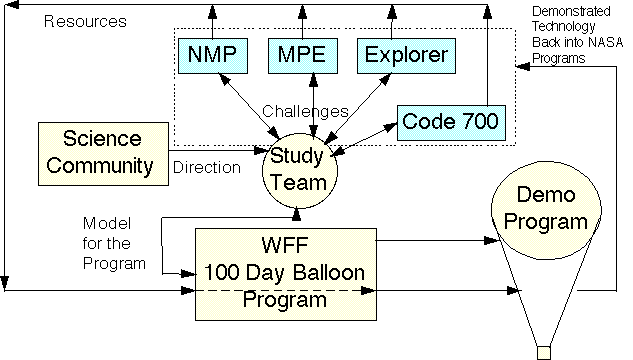
The study team includes personnel from NASA-GSFC,
WFF and members from the science community. Figure 1 depicts
the conceptual organization and information flow of the integrated
study team. Each member of this study team brings specific areas
of knowledge and experience. The roles of each member is broadly
defined as follows:
GSFC Wallops Flight Facility Role
- Wallops will be the official residence of the balloon program.
- Strong experience base and expertise
- Organize the demonstration program based on GSFC findings
- Primarily responsible for Safety, Operations and Balloon
GSFC Greenbelt Role for demonstration
for future program
- Science feasibility study
- Identify technologies and practices for transfer; operations and options
- Determine a model for 100 day balloon missions
- Expertise in long duration space missions and new satellite technologies
Organization Of The Study Team (Continued)
- Primary responsibility for recommending Communications Options, Power, Thermal, Pointing and Interface Standards
Science Community
- Provide requirements for strawman missions
- Provide feedback regarding technology options
- Direct and redirect study
NASA Headquarters
- Oversee and facilitate international aspects of the ULDB Program.
- Plan for and coordinate infrastructure supports, e.g., TDRSS.
Schedule For The Study And The Demonstration Program
SUPERPRESSURE INITIATIVE MILESTONES
| MILESTONE | DATE |
| Initial Planning Discussion | 6/96 |
| GSFC Commitment | 10/31/96 |
| Workshop Begins GSFC Study | 10/31/96 |
| First Hangar Tests | 2/21/97 |
| Demonstration 2000 Science Candidates Identified | 4/11/97 |
| Interim Requirements & Technology (R&T) Report | 4/15/97 |
| Integrated Management Team (IMT) Established | 5/1/97 |
| Technology Workshop (GSFC) | 6/24-25/97 |
| Final R&T Report | 9/1/97 |
| Conceptual Design Review | 10/15/97 |
| Test Flight : Balloon Technology : 0.2 mcf (New Zealand) | 11/17/97 |
| Test Flight : Balloon Technology : 1-2 mcf (CONUS) | 2/2/98 |
| Preliminary Design Review | 3/18/98 |
| Demonstration 2000 Science Instrument Selection | 3/25/98 |
| Test Flight : Balloon Technology : Full Scale (CONUS) | 9/15/98 |
| Critical Design Review | 10/14/98 |
| Test Flight : Ballooncraft Systems (New Zealand) | 11/16/98 |
| Mission Readiness Review : Integrated Systems Flight | 3/12/99 |
| Test Flight : Integrated Systems (CONUS) | 4/15/99 |
| Mission 2001 Science Instrument Selected | 4/30/99 |
| Mission Operations Review : Demonstration 2000 Flight | 5/12/99 |
| Mission Readiness Review : Demonstration 2000 Flight | 10/6/99 |
| Demonstration 2000 Flight | 1/1/00 |
| Mission 2001 Science Flight | 1/1/01 |
The above is based upon the assumption that the IMT will be fully composed by May 1st.
The following discussion provides some details regarding the events that have occurred.
100 day balloon workshop Oct. 31, 1996-Nov. 1, 1996
- A workshop was organized to introduce the 100 day balloon program concept and study to the science community. Personnel from NASA HQ and GSFC (Greenbelt and WFF) participated in interactions with the science community to generate new concepts and requirements.
- The workshop was organized into "splinter groups" based on science discipline. Five splinter groups were formed: Atmospheric Science, Cosmic Ray, Gamma Ray, Infra Red and Solar Ray.
- The splinter groups were asked to develop ideas and specific requirements for strawman missions. These strawman missions had to define science that is not achievable under the current balloon program and identify enabling technologies important to other NASA missions such as the New Millennium, Mission to Planet Earth and the explorers and incorporate them into Long Duration Balloon missions to test them. The splinter groups were asked to provide the following information for each strawman mission.
- Weight
- Altitude Range
- Power and power profile
- Thermal requirements
- Pointing knowledge and stability
- Location of balloon, launch and desired drift
- Data return requirements
- Commanding requirements
- PI operated or otherwise
Summary Of Results From The Workshop
A summary of expected performance requirements collected from workshop participants have been summarized in the following tables and charts.
Table 1 is the collection of Strawman mission requirements from the science community.
Table 3 is a summary tabulation of the communications requirements.
Figure 2 displays the range of altitude requirements by science discipline and indicates the percentage of experiments that would be satisfied by certain altitudes.
Figure 3 displays the range of science instrument weight requirements by science discipline and indicates the percentage of experiments that would be satisfied by certain weight capabilities.
Figure 4 displays the range of science instrument power requirements by science discipline and indicates the percentage of experiments that would be satisfied by a certain power in Watts.
Figure 5 displays the range of science instrument pointing accuracy requirements by science discipline and indicates the percentage of experiments that would be satisfied by certain values in degrees, arcminutes, or arcseconds.
Figure 6 displays the range of science instrument
data rate requirements by science discipline and indicates the
percentage of experiments that would be satisfied by a various
data rates.
| SCIENCE DISCIPLINE | Discipline lead/PI | PROGRAM | AFFILIATION | LOCATION | ALTITUDE | POINTING ACCURACY | POINTING KNOWLEDGE | DATA RATE | DATA COLLECTION | COMMAND FREQUENCY | POWER REQUIREMENT | SCIENCE INST WEIGHT | THERMAL REQUIREMENT | TIME PER OBSERVATION | RESPONSE TIME | SCIENCE DATA DELAY | DATA DURING COMMAND | EXPENDABLE REQUIREMENTS | PI OPERATION OR SUPPORT GRP | Recovery | Focal Length |
| Gamma Ray | Jack Tueller | ||||||||||||||||||||
| Consensus of Meeting splinter | 40 N to 40 S latitude | 115,000 min >130,000 des | arc min | NR | <10kbps min 100-300kbps | Low rate continuous | Continuous | 100 - 500W | 1500-3000 lb | Instrument cooling | Duty cycle min 50%, 100% des | R/T | Intermittent acceptable | Continuous | Cryogens | NR | NR | ||||
| High Resolution Imaging | Bill Craig | Columbia | Lower Latitudes | 125,000 ft | Arc min, Sidereal | 10 arc sec processing | 400-600 kbd (300-400kbps) | Continuous | Daily | 200 - 300 W | 2000 lb (1700 lb) | Normal Balloon | Hours | Some R/T | Daily | Desirable | None | PI | NR | ||
| Compton Telescope | Elena Aprile | Columbia | S hemisphere | >125,000 ft | N/A | 10 arc min | 400-600 kbd | Continuous | Daily | 300 W to 1 kW | 2000 lb | Normal Balloon | Hours | NR | Daily | Not required | Possibly Cryogens | PI | NR | ||
| Hard X- Ray Survey | Josh Grindlay | EXIST-LITE | 40N to 40S lat. | 125,000ft. (120kft. min.) | N/A | 5 arcmin | 100kbs continuous w/o compression | continuos, burst-dumped ~4X/day | 2-4X/day | 300W | 2000lb | normal balloon; 0-20 deg C | continuous survey | R/T desired | real-time desired, 1 day minimum | not req. | None | PI | desired | ||
| Hard X- Ray Survey | Mike Pelling | HEXIS | UCSD | Mid latitudes | 36 km min 40 km des | 20 arc min | 1 arc min | 10kbs R/T tlm, 100 kbps | NR | Twice per day | 150W | 2200 lb | Inst 0-20 deg C elec 0-40 deg C | NR | NR | R/T to hours | Yes | NR | NR | NR | |
| spectroscopy of diffuse lines | Juan Naya | GSFC | low latitudes | >110,000 ft | none | 5 deg azimuth | 4 Mbits/day | Continuous | twice daily | 500 - 700 W | 2000 lb | cryogenic | 100 days | NR | weekly | not required | maybe cryogen | PI | NR | ||
| X-Ray/Gamma Ray Astronomy | Michael Cherry | MARGIE | LSU/Louisiana Tech/UNH | NR | NR | NR | NR | NR | NR | NR | NR | NR | NR | NR | NR | NR | NR | NR | NR | NR | |
| High Resolution Imaging | Jack Tueller | GSFC | low latitudes | >125,000 ft | 1 arc min | 0.2 arc min | 1 Kbps | Continuous | twice daily | 300 W | 2400 lb. | normal | 10 mins - 10 hours | NR | weekly some R/T | not required | none | PI | NR | 8 meters | |
| GRB Polarimetry | Scott Barthelmy | GSFC | low latitudes | >115,000 ft | N/A | 1 deg | 5 - 10 Kbps | Continuous | few per week | 100 W | 250 lb | inst -10 to 44 deg C | continuous | need R/T for 500 bits | weekly some R/T | not required | none | PI | NR | ||
| Compton Telescope | Allen Zych | TIGRE | Low latitude southern | 120,000 - 130,000 ft | NR | 10 arc min | Sci 100 kbps TLM 5 kbps | Continuous | 25 per day | 500W | 440-2200 lb | 0-30 deg C | NR | NR | 5 kbps R/T Sci EOM | Cal prior to mode change | NR | PI | Recover data min | ||
| SOLAR | Brian Dennis | ||||||||||||||||||||
| X-ray spectroscopy | Bob Lin | HIREGS | UCB | Open | 125,000 to 130,000ft | 6 arc min | <1 arc sec | 2 kbps hi pri Total10kbps | Daytime | Autonomous O.K. 100B/6hrs | 400W 300W stby | 1100lb | Det 0-20deg C Elec 0-40deg C | NR | NR | Recovery of data bank | NR | NR | PI pref | Highly Desirable | |
| Gamma-ray spectroscopy | Edward Chupp | UNH/Columbia/GSFC | Hi latitude, max daylight | >/=115,000ft | 10 arc min | 0.5 arc min by inst | 40 kbps 4kbps comp | Daytime | 300 bps, 4/day | 500W | 3300lb | NR | One flare above 20 MeV, min | NR | Recovery of data bank | NR | Liquid nitrogen | PI | Highly Desirable | ||
| Hard X-ray, G-ray spectroscopy | Jim Ryan | UNH | Low latitudes | <5 g cm squ | 3 deg | 1 deg | 1 GB/day | Daytime | Once per day after C/O | <200W | <500lb | 0 to 20 deg C | One flare min | NR | NR | NR | NR | PI | Recovery of data | ||
| Helioseismology Magnetic energy | David Rust | Flare Genesis | APL/JHU | Max daylight | >105,000ft | 20 arc sec | 20 arc sec | 10 GB/day | Daytime | Medium autonomy | 800W | <3300lb | Balloon qualified | NR | NR | Recovery of data | NR | NR | PI pref | Critical | |
| Asterseismology | Derek l. Buzasi | BLAST | Valdosta St. U | >90,000ft | 5 arc sec stab | 39 arc sec | <10 MB/day | Night time | Minimal, safety | 300W | 2000 lb | Stability of optical system | NR | NR | NR | NR | NR | NR | Recovery of data pref | ||
| Ed Cheng | Tailor to Location | >100,000 ft | Few arc min | 1 arc min | 32-100 kbps | Continuous | Load or R/T <100/min | 100 - 300 W | 500-1000 lb | Heater Control | Hours | Some R/T | Weekly, some R/T | Most Likely Not | Cryogens | PI | NR | ||||
| Solar G-mode, oblateness | Larry Twigg | GSFC | Polar trajectory | >115,000ft 125,000 des | 1.5 arc min 7 arc sec stab | .1 arc sec autonomous | <10 MB/day flexible | Daytime | Near launch mainly auto | 300W | 800 lb | Good history | NR | NR | 20 days | NR | NR | Pref strong PI | NR | ||
| Solar | Bill Heaps | Solar disc sextant | GSFC | High latitude pref | 115,000ft min 125,000 pref | Self pointing | NR | 0.5 Mbps compressed | Day time | Early mission occasional | 100W | 800 lb | Pref continuous sun viewing | Continuous in day light | NR | EOM | Cal prior to mode change | NR | PI | Recover data min | |
| Cosmic Ray | Bob Streitmatter | ||||||||||||||||||||
| Jim Adams | NRL | Polar, low cutoff | 100,000 ft to 130,000 ft | NR | None | 10 bps, burst rate 2kbps | Continuous | To dump data, minimal | �500W continuos | 500 lb | -30� C to + 50 � C | NR | NR | Any delay is okay | NR | NR | PI | to save replacement cost | |||
| TIGER | WU/GSFC/UM | >�50 deg. | 115,000 ft >120,000 des | NR | NR | 14 kbps | NR | Minimal | �200W | 1500 lb | 0�T�30� C | NR | NR | NR | NR | NR | NR | NR | |||
| Si-Cal | Any | 115,000 ft >120,000 des | NR | NR | 200 kbps | NR | NR | 250W | 2200 lb | NR | NR | NR | NR | NR | NR | NR | NR | ||||
| JACEE+ | LSU/UW/UAH/MSFC/Japan/Poland | Mid latitudes | 100,000 ft >120,000 des | NR | NR | 10 kbps | NR | NR | <150W | 2000 lb | NR | NR | NR | NR | NR | NR | NR | Waterproof | |||
| SOFCAL | 100,000 ft >120,000 des | NR | NR | <200 kbps | NR | NR | 200W | 2000 lb | NR | NR | NR | NR | NR | NR | NR | NR | |||||
| BACH | >+/-50UH | 100,000 ft 120,000 des | NR | NR | 0.020 kbps | NR | NR | 300W 50% Hi latitudes | 750 lb | NR | NR | NR | NR | NR | NR | NR | NR | ||||
| Cosmic Ray | E. G. Stassinopoulos | PHA Instrument | GSFC | > �50� | 100,000 ft 120,000 des | NR | NR | 512 bytes per reading | Once per day | NR | +5V and -5V <2W | 1 lb | NR | Continuous | NR | NR | NR | NR | NR | Desired, not required | |
| Atmospheric | Bill Heaps | ||||||||||||||||||||
| GSFC | Southern Alice Springs | >30km | Degrees | NR | 20kbps | Continuous | NR | 400W | 440lb | NR | Continuous | NR | NR | NR | NR | NR | NR | ||||
| Infrared | Ed Cheng | ||||||||||||||||||||
| Far IR | HFLOS | NR | 98,5000 - 131,300ft | NR | NR | 32kbps | NR | Daily | 150W | 330lb | NR | NR | NR | Daily | NR | NR | NR | NR | |||
| Gregory Tucker | SAO | High latitudes >70 degrees | >100,000 ft | 20 arc sec | NR | 1- 20 kbps | Continuous (dark) | Hourly | NR | <2000 lb | Instrument cooling | 20 minutes | R/T | R/T to 15 min delay | Required | Liquid helium | support group | NR | |||
| Cosmic anisotropy | Brown U | NR | NR | Spin scan | NR | 200Bps | Night time | Daily | NR | 1500 lb | 4 deg K cold plate | Night time | NR | Continuous | NR | Liquid Helium | NR | NR | |||
| Anisotropy package | GSFC | NR | NR | Spin scan | 3', 1', 10" order of pref | 200Bps | NR | NR | 750W/600W | 440-2200lb | NR | NR | NR | Continuous | NR | NR | NR | Highly desired | |||
| CMB | HEMT | NR | NR | NR | NR | 50kps, 5k compressed | NR | NR | 150W operating | 800lb | NR | NR | NR | Continuous | NR | Liquid Helium | NR | NR | |||
| GEM/ICONS | M. Mahoney | JPL | NR | NR | NR | NR | 10- 20 kbps (& raw video) | NR | 1-100 min | 200 W | 440-660 lb | Instrument cooling | NR | R/T | R/T | Required | Cryogens | Open | NR | ||
| MISC | |||||||||||||||||||||
| Extra-Solar Planets | C. Ftaclas | Balloon Borne Detection of Extra-Solar Planets | MTU/JPL | High latitude, need 2 93+ day flts., one at each pole, night. | >30 km | <1 arcmin by balloon craft. <1 arcsec by instrument | NR | 35 kbps | NR | every 16 hours | NR | 1000-3000 lb | NR | 30 min | R/T every 16 hours for acquisition of target (star) | Storage okay for later transmission | Required for acquisition, could compress for cellular. | Maybe, detector needs to be cooled. | PI | Desired, telescope expensive | 6 m long telescope, off axis design. 1.5 m aperture. |
Table 1
| 100 Day Balloon Workshop - Envisioned Communication Requirements | |||||||
| |||||||
| Gamma Ray | High Resolution Imaging | Bill Craig | 0.60 | 0.06 | 1 | ||
| Gamma Ray | Compton Telescope | Elena Aprile | 0.60 | 0.06 | 1 | ||
| Gamma Ray | Hard X-Ray Survey | Josh Grindlay | EXIST-LITE | 100 | 8640.00 | 864.00 | 4 |
| Gamma Ray | Hard X-Ray Survey | Mike Pelling | HEXIS | 100 | 8640.00 | 864.00 | 1 |
| Gamma Ray | Spectroscopy of Diffuse Lines | Juan Naya | 4.00 | 0.40 | 2 | ||
| Gamma Ray | High Resolution Imaging | Jack Tueller | 1 | 86.40 | 8.64 | 2 | |
| Gamma Ray | GRB Polarimetry | Scott Barthelmy | 10 | 864.00 | 86.40 | 1 | |
| Gamma Ray | Compton Telescope | Allen Zych | TIGRE | 100 | 8640.00 | 864.00 | 25 |
| Solar | X-Ray Spectroscopy | Bob Lin | HIREGS | 10 | 864.00 | 86.40 | 0.1 |
| Solar | Gamma-Ray Spectroscopy | Edward Chupp | 40 | 3456.00 | 345.60 | 4 | |
| Solar | X/G-Ray Spectroscopy | Jim Ryan | 8000.00 | 800.00 | 1 | ||
| Solar | "Helioseismology, Mag. Energy" | David Rust | 80000.00 | 8000.00 | 0.1 | ||
| Solar | Asterseismology | Derek 1. Buzasi | 80.00 | 8.00 | 0.1 | ||
| Solar | Ed Cheng | 100 | 8640.00 | 864.00 | ? | ||
| Solar | "Solar G-Mode, Oblateness" | Larry Twigg | 80.00 | 8.00 | 0.1 | ||
| Solar | Solar | Bill Heaps | 500 | 43200.00 | 4320.00 | 0.1 | |
| Cosmic Ray | Jim Adams | 2 | 172.80 | 17.28 | 0.1 | ||
| Cosmic Ray | TIGER | 14 | 1209.60 | 120.96 | 0.1 | ||
| Cosmic Ray | Si-Cal | 200 | 17280.00 | 1728.00 | |||
| Cosmic Ray | JACEE+ | 10 | 864.00 | 86.40 | |||
| Cosmic Ray | SOFCAL | 200 | 17280.00 | 1728.00 | |||
| Cosmic Ray | BACH | 0.02 | 1.73 | 0.17 | |||
| Atmospheric | Bill Heaps (?) | 20 | 1728.00 | 172.80 | |||
| Infrared | Far IR | HFLOS | 32 | 2764.80 | 276.48 | 1 | |
| Infrared | Gregory Tucker | 20 | 1728.00 | 172.80 | 24 | ||
| Infrared | Cosmic Anisotropy | 0.2 | 17.28 | 1.73 | 1 | ||
| Infrared | Anisotropy package | 0.2 | 17.28 | 1.73 | |||
| Infrared | CMB | HEMT | 50 | 4320.00 | 432.00 | ||
| Infrared | GEM/ICONS (raw video!) | M. Mahoney | 20 | 1728.00 | 172.80 | 100 | |
| Extra-Solar Planets | Balloon Borne Detection of Extra-Solar Planets | C. Ftaclas | 35 | 3024.00 | 302.40 | 1.5 | |
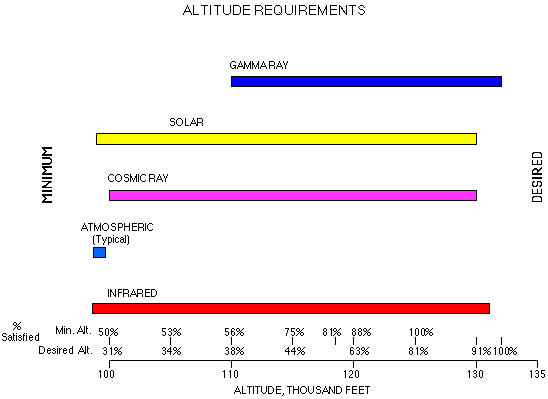
Figure 2 Altitude Requirements Summary
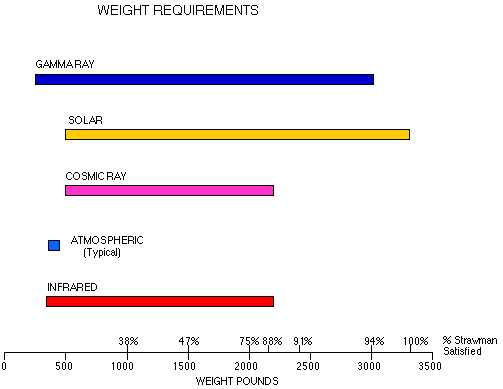
Figure 3 Weight Requirements Summary
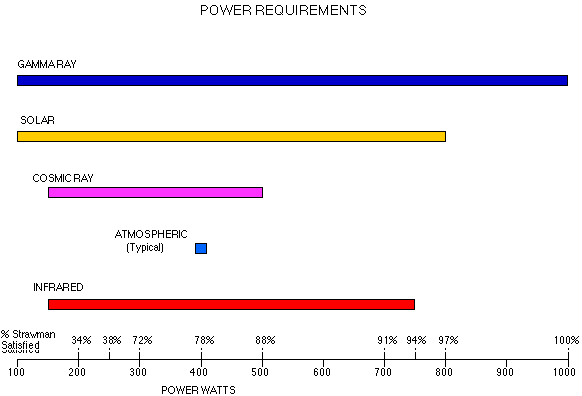
Figure 4 Power Requirements Summary
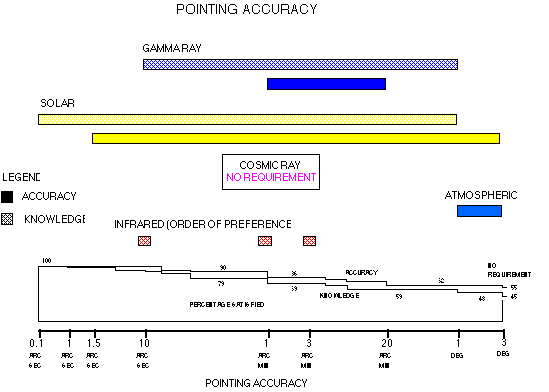
Figure 5 Pointing Requirements Summary
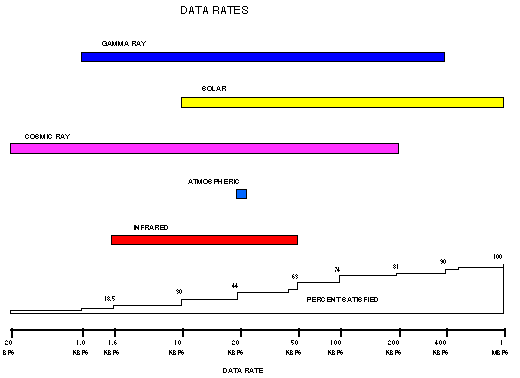
Figure 6 Data RatesRequirements Summary
Preliminary requirements based on 32 strawman experiments in the spreadsheet (the gamma-ray group consensus was not included in the statistics).
Minimum Science Requirements:
- Need to achieve an altitude of >115 kft to satisfy 75 % of the strawman experiments.
- Need to achieve an altitude of >125 kft to satisfy 100 % of the strawman experiments.
- Need to achieve >400 Watts power to satisfy 78 % of the strawman experiments.
- Need to float >2000 pounds science weight to satisfy 75 % of the strawman experiments.
- Recovery is desired by most missions, but not required.
- Latitudes higher than 70° are required by 7 experiments.
- A thermal control system maintaining a temperature in the range from 0°C to 20°C appears to satisfy all the experiments.
- Pointing accuracy/knowledge requirements range from none to spin scan, to a few degrees, down to sub-arcseconds. There are 3 to 4 distinct clusters to satisfy. Pointing under 1 arcminute will be a challenge.
- Data collection occurs continuously for 11 experiments, daytime only for 6 experiments, night only for 4 experiments and 11 experiments provided no requirement.
- 50 % of the experiment Principal Investigators wished to operate as a PI mission.
- Per day data volumes up to 80 Gigabits.
Design Options Needed Based On Science Requirements
(Mission
operations profiles or concepts based on the strawman science
payload requirements from the October 96 workshop)
There are two concepts with different requirements
based on latitude.
- Inside The Arctic Or Antarctic Circles
- Night time operations require nonsolar power source
- Reliable communications for polar zones of exclusion
- Geostationary communications satellites can not see poles
- Many of the LEO, Little LEO & MEO communications
ventures tend to have
- 60° inclined orbits, again excluding the poles
- Need to find
those with coverage at the poles. There are at least 3 known
candidates --
- IRIDIUM, low data rate
- GLOBALSTAR, 19 kbps
- ICONET, rates unknown
- Need to investigate Military Communication Satellites ( U.S., Russian, etc.)
- Need to investigate amateur radio operators communication satellites.
- 100 day missions will experience extreme day/night
cycles
- need to design for 60 day long days and nights
- 4 experiments want day time observations
- this limits mission to ² 60 days
- 2 experiments want continuous dark
- this allows 100 day mission with substantial power needs
- 1 experiment wants continuous observations
- this allows 100 day mission (30 to 60 days sun then 40 to 70 days dark)
- 4 experiments want day time observations
- this impacts the power design and
- the thermal design
- need to design for 60 day long days and nights
- equipment needs to survive radiation at magnetic poles
- risk of cutbacks in NSF program (cost would become great)
2. Low Latitude
- Need to
investigate
power systems sufficient for the science instrument and the support
system
- a sun tracking solar array or an omni directional array
- battery or other storage for 12 hours
- non-traditional power source, e.g., wind/electrical generator a few 1000 feet below balloon
- requires thermal control for 12 hour day/night cycle
- may require pointing control for communications antenna
- may require new international agreements
- inadvertent technology transfer considerations
Design concepts common to both latitude options described
above are as follows.
1. The payload will be "tracked" continuously
from a central ground station.
2. Trajectory forecasts will be maintained and continuously updated.
- forecasts will include wind predictions.
3. Real-time data and commanding will be available at the launch site, central ground station, and PI institution.
- Need to design for a line of sight in flight checkout period after launch (~ 5-6 hours duration)
- 50% of PIs want PI mode of operation.
- Science data will be recovered at a frequency that insures mission success and no more than 25% of accumulated data is lost.
5. Science instrument pointing requirements show need for four different systems. Appropriate modular design and interface needed.
- No pointing required
- Spin scan system required
- Pointing to one arcmin required
- Pointing to arcsec and sub-arcsec required
Current Balloon Program Capabilities
- Power - The SIP provides 300 Watts, as an upper limit 600 Watts has been supported.
- Commanding & Data Return - Omni/TDRS supports 2 kbps, up to 6 kbps maximum supported.
- Thermal design - The thermal environment is much more severe than the typical spacecraft environment when looking at the cyclic thermal loads. The thermal analysis techniques and control methods employed for ballooning are fairly well established and have been proven on many flights. Most of the control methods are passive and do not require thermal blankets or complicated active systems. The tools currently used are TRASYS, SINDA, and TSS. Due to the long days and nights a totally passive system may not be possible. The required power allocation for thermal control may be higher than for a typical spacecraft which is around 5%.
- Automated operations - These include 1) an aneroid flight termination switch in the event a balloon descends below a minimum acceptable altitude for flight safety; 2) a burst detector which will terminate the flight in the event of a balloon structural failure; 3) an automated balloon differential pressure control/valve system for pressurized balloon systems; and 4) an automated ballast control system for the dropping of ballast for maintenance of altitude.
- Location of Balloon Craft - Balloon/ballooncraft position is determined on-board by redundant GPS receivers with the information transmitted to the ground station through the FM/PCM line of sight link, the INMARSAT Standard C over-the-horizon (OTH) link, the HF/ARGOS OTH link, or the TDRSS MA or SA link. In addition, position is also obtained vis ARGOS PTT's (Platform Transmitter Terminal) received at the Wallops Remote Operations Control Center or the Palestine Operations Control Center.
Areas Requiring Further Technical Definition
The information received from the science community
has some requirements that appear technically challenging. This
section attempts to describe some of the areas that require more
technical definition.
Weight:
Some of the strawman missions have requirements of up to 3300
lbs., many require 2000 lbs. For the demonstration mission only
a 2000 lbs hang weight is advertised. This is a challenge for
the ULDB program.
The system weight must be viewed from a system standpoint.
There are many areas where the structural system can be "designed"
instead of "built" for significant weight savings.
This requires a weight analysis for each mission.
Power:
Some
of the strawman missions require over 800 Watts of power. The
challenge is to meet higher power needs with manageable impact
to weight and stability. An engineering trade study is needed
to identify which power source might best meet the needs of the
ULDB program. Some potential candidates for power sources are
provided in the Summary List Of Technologies Under Consideration
section beginning on page 40.
A combination of the different types of power systems
may be the solution.
Location: Redundant
GPS will provide location information. ARGOS is currently used
as a backup position source.
Pointing Control: Several
of the strawman missions require pointing control and knowledge.
The challenge will be to achieve the desired accuracy in a craft
acting like a pendulum with some elasticity in the load train.
Also, for those missions requiring a lot of power the size of
the solar arrays could introduce jitter into the system.
Candidate pointing systems for study are provided in the Summary List Of Technologies Under Consideration section beginning on page 40.
Terminate and Recovery
Systems
Payload recovery is not a requirement.
- It is desired by the majority of PIs.
- High data rate line-of-sight telemetry and preemptive cut down plans for recovery and re-flight in case of payload failure may be feasible for some missions.
A study on feasibility and systems needed should be performed.
- An alternative concept could be developed for payloads that require recovery with defined tradeoffs.
- An aircraft could be made available at potential termination areas for cut down and recovery operations.
- Recovery systems (parachute) could be deployed on flights.
- Is a self-destruct system needed?
- Other terminate and recovery options for evaluation
are:
- steerable parachute systems to improve recovery operations,
- ground transmitter to ease finding
a lost payload,
- look at animal collar systems,
- emergency transmitter systems,
- inflatable flotation devices,
- "smart" auto cut down systems that use GPS + wind predictions, and
- improved wind prediction.
Autonomous Operations: This is desired on many of the strawman missions and will likely be needed on most missions to handle functions like thermal stability, battery discharge and charge cycles, other day/night cycle activities, and to execute safety procedures under various scenarios such as failure of balloon location communications with the operations team. These systems need to be designed and tested to provide high probability of survival for 100 days at altitude.
Thermal: Thermal control needs to be maintained to within the required operations temperature range for both the science instrument and the support package. The tools currently use for thermal analysis are TRASYS, SINDA, and TSS. They are proven for the existing balloon programs; they have yet to be proven for the ULDB Program. The following tasks need to be undertaken to provide models to help evaluate different ideas for maintaining thermal control of the balloon craft packages.
1) Characterize the range of wind speeds likely to be encountered by a balloon payload at float. An initial estimate can be obtained from existing measurements of wind speed vs. altitude which NSBF takes with their routine soundings, by taking the derivative of this curve and multiplying by the length of the flight train.
2) Develop a model for wind cooling at float conditions. There is likely already such a model at least for pressure ~1 atm; if not it is fairly clear how to develop the framework, since the airflow is likely to be nearly laminar. If necessary, develop a plan to validate this model for float conditions.
3) Develop a model for convective cooling, or establish design rules under which convection can be safely ignored.
These are only models to help determine thermal design.
Since a consistent, half degree increase or decrease in the temperature
could put the balloon craft into a non-operating state, a challenge
will be to devise a test strategy that can ensure high probability
of thermal survival of the balloon craft for ³100 days.
Additional systems for cooling or heating will be needed for some
of the experiments. An area of concern is that these additional
systems will impact power requirements for the balloon.
Communications: There appear to be low rate options that can accomodate both commanding and return of the balloon craft and science instrument engineering and housekeeping telemetry. Costs of various options needs to be studied. Options for the return of high rate science data are limited and need further study. Some of the strawman missions require real time response. Some of the experiments call for daily data return, daily commanding or even hourly commanding. This raises the question of what is an acceptable level of cost. TDRSS and Military satellites cannot be relied on to give balloons top priority, other options should be explored. Table 4 outlines initial information on some of the communications options that need further study. Figure 7 provides a high level concept for communications requirements and packaging schemes.
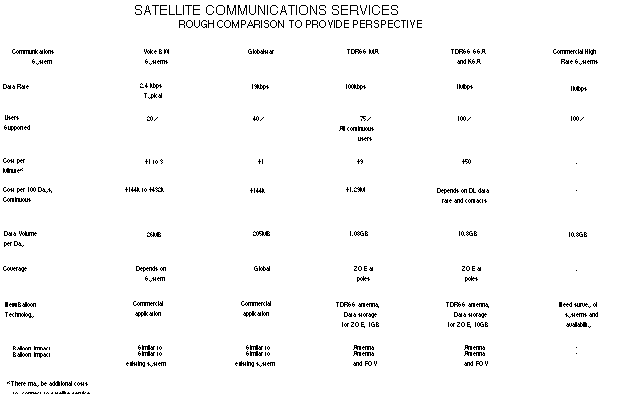
Table 4 Rough Comparison of Possible Satellite Communications Service Options
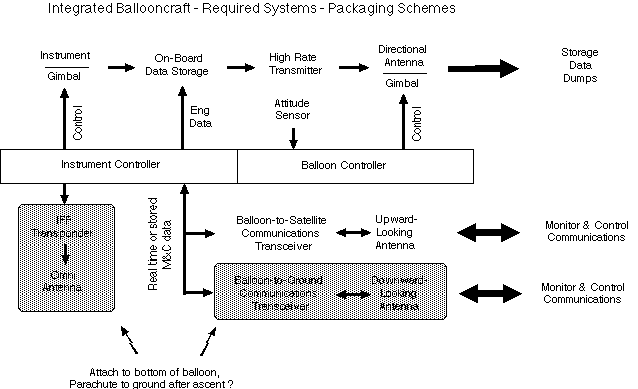
Figure 7 High Level Communications Concept
Continuous Coverage
Continuous coverage may not be possible, practically
or due to cost. There are two ways to go: non-continuous communications,
or meeting the PI's requirements. It is not clear if much thought
has been given to continuous coverage issues such as personnel
to monitor communications around the clock for 100 days or the
cost to support such operations.
Zones of Exclusion
An initial calculation of the zones of exclusion
is presented in Figure 8. The ZOE is described for a 3 TDRSS
system, expected in the future, not currently (2 TDRSS system).
If the balloon drifts into these zones there needs to be an alternate
way to contact the balloon for safety reasons. These issues are
under study.
A hybrid solution of a 2 kbps communications connection
for command and housekeeping and a higher rate line for data return
may be appropriate and will be studied.
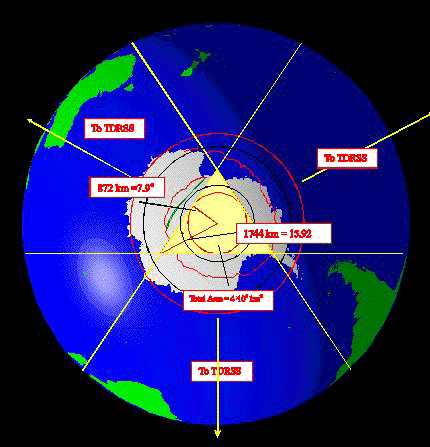
Figure 8 Plot of a Balloon Ground Trace and
the ZOE at the Poles
System Engineering
Information and Concerns
How might the physical environment affect the balloon
craft? This relates to passage to altitude and in retrieval as
well as operation at the limits of the atmosphere in the range
of 100,000 ft to 130,000 ft. The balloons may fly mainly around
the poles or in equatorial areas. Conditions that may affect the
balloons performance and integrity are of concern. A summary
of the known balloon environment follows.
Balloon Environment Summary
Balloon Behavior:
Balloon Ascent Rate : typical 800-1000 fpm. It takes around three hours to attain altitude.
Balloon Rotation Rates : typical < 60 deg/min at float
have seen during ascent/descent ~ 180 deg/min
Balloon Dynamics : (Vertical Oscillations & Frequency
Forthcoming)
Loads:
Launch : typical < 1.5 g's
Ascent : typical < 1.1 g's due to wind shears, ballast drops, etc.
Terminate : typical < 10 g's
Impact Velocity : typical < 20 fps
Wind or wind shear effects TBD. This is particularly
important for those experiments that require pointing accuracy
and have large power demands.
Release acceleration - 10 g pulse when parasail opens.
The termination loading can be around 10 g's. We
have typical curves for the acceleration and velocity at termination
for balloon payloads. The implementation of a flight termination
load reduction technique is now being explored using a rip stitch
attenuator. This promises to reduce the 10 g loading by half
or more. The technique used could also be tailored to the specific
payload to reduce the shock loading even more. The method and
procedure to do this has been determined and it is a matter of
implementation and testing.
Landing acceleration (use airbags like the Mars lander)?
This is a known quantity, and much less severe than
the release accelerations. Crush pads are not as elegant as an
airbag system, but can be easily designed to do the job for minimal
weight, minimal complexity and minimal cost.
A related issue to all of the accelerations that
a payload may see concerns what constitutes a fully recovered
payload. It is obviously not acceptable to have pieces fall off
the payload at termination and then fall to the ground. Depending
on the parts, it may be acceptable for them to become non-functional
at termination or upon ground impact. This is an area for a trade
study or cost benefit analysis. The core of the instrument which
accounts for most of the cost of the payload may be able to handle
the imposed acceleration loads. The associated costs and increased
weight to ensure survivability of the other parts may not be worth
it. Some items could be considered as "throw away"
if the effort to ensure survivability costs more than replacement/refurbishment.
This should all be put in the context that the main
acceleration event is after the operating portion of its life.
This is exactly opposite of a launched spacecraft which sees
its worst accelerations at launch before being put into operation.
One could envision, for example, a detector system that is built
to handle the launch acceleration, but not the termination event.
To build the same detector that can survive the termination would
be a significantly heavier and more expensive.
Atmospheric :
Tropics : -90C @ ~ 50-60 k-ft altitude
Polar : -45C @ ~ 30-35 k-ft altitude
mid-latitude : -55C @ ~45-60 k-ft --> -80C in summer
(seasonal & latitudinal fluctuations)
Temperature profile - Troposphere can reach -90C
and balloon can take 20 to 30 minutes to travel through the troposphere
during launch. Launch temperature range can be from -10_C to
+40_C
Chemical components and vapor levels TBD.
Radiation:
Solar Constant (seasonal) : 1358 W/m2 (nominal)
1312 W/m2 (minimum)
1404 W/m2 (maximum)
Albedo : 0.1 (minimum)
0.9 (maximum) polar
Earth Flux: 90.7 W/m2 (minimum, Tropospheric cloud top temperatures of -90°C)
594. W/m2 (maximum, Desert @ 320K planet temperature)
Electro-static gradients, Electro-magnetic fields
TBD.
Lightning Strike:
A concern at high altitudes is lightning strikes
at float altitude coming up from clouds below (which has happened
catastrophically on one mission) when flying across severe storm
boundaries and the type of payload. Special hardening of instrumentation
or procedures may need to be developed.
Programmatic System Engineering Concerns
In studying the Balloon craft subsystems
the Balloon Program needs to be tied into NASA objectives. We
need to identify NASA needs that correspond to the Balloon Program
needs. Examples are given below.
Data Collection - Which methods is
more useful to future NASA missions? Satellite cellular command/TDRS
telemetry link hybrid would be of interest to some small missions,
what are other options?
Thermal - What new thermal control
systems being designed for use in space might have application
on balloons?
Power - Are there new solar cells,
storage batteries, or fuel cells not yet tested that could be
used on a balloon craft to provide test data useful for future
space missions.
Pointing Control and Autonomous Operations
- Can the balloon program perform pathfinder flights that test
new technology that could be used on small satellites or proposed
balloon exploration of other planets?
Risk Mitigation - Can any of the new
technologies identified be flown on current LDB programs to reduce
to the 100 day programs?
Differences between balloon and space
mission or ground experiment
- Launch
- Large static charges can be generated during balloon inflation
- Minimal vibration
- Three hours needed to attain altitude
- Restrictions based on launch vehicle
- In Flight Check of Balloon craft
- Operation
- Long day/night cycles
- Long periods in the ZOE
- The Environment
- Different radiation environment
- Residual atmosphere
Other Issues Beyond The Scope Of This Study But Impacting The Program
- State Department Concerns on Technical Transfer.
- Risk Of Cutbacks In NSF Program (Cost Would Become Great).
- Adequacy of Launch support services.
- Does the launch site need upgrading?
- General International Agreements.
- International involvement in development.
Summary List Of Technologies Under Consideration
(This is a partial list given that all study team members are not yet onboard.)
(This will be a summary list of items identified
in the report, it is not yet complete.)
Communications
Use of various communications satellite options.
- TDRSS
- Commercial (Little LEO, LEO, MEO, Geosync.)
- Military (USA, Russian)
- Amateur Radio Operator Satellites
Use of new Antenna Technologies.
Also various options on storage media drops over recoverable site.
- Ruggedized Mass Data Storage Device
We are seeking a very low cost, compact,
rugged mass data storage system with >1 terabit capacity.
We are seeking a reusable system in the <$100K range. Several
of these systems will be used for on-board recording in the Advanced
Long Duration Ballooning Program. Data will be recovered by
parachuting to the ground (must withstand 10 g shocks). The drop
package could be the whole system or just storage components.
Multiple drops are required for reliable recovery of the data.
The system needs to be able to operate at altitudes between 100000
and 130000 feet (pressures between 11 and 3 millibar). It needs
to operate from a 28 V unregulated battery input. The operating
temperature range without thermal control may be extreme so that
extended operating temperature range is desirable.
Balloon Craft Location
- GPS
- Weather Based Predictions
Power Systems
Some potential candidates for power sources are:
- Solar Arrays
- The system must be designed, weight and size, for the worst case operating conditions for each, the polar flights and the low latitude flights. The size of the system is not as much a concern as the size of the stowed system for launch. Deployable arrays, which can be either unrolled or inflated, may be a very desirable option. A sterling engine may also be an approach for using solar energy.
- New battery technology (rechargeable Lithium
batteries?)
- we want deep discharge but only 100 cycles + some TBD margin.
- A fuel cell system can be attractive for high power "short" flights (1 kW, 20 days) or for moderate power for longer flights (200 W, 100 days). Fuel cells also offer the advantages of "waste heat" for thermal control, water drops for ballasting, and the possibility of using the waste water for thermal storage (solar heated during the day and acting as a supplemental heat at night).
- Flywheel energy storage systems
- Wind power generators suspended a few hundred or thousand feet below the balloon craft.
Thermal Systems
- Thermal Blankets that will work at balloon flight altitudes.
- High Efficiency Heat Pump System
We are seeking a high efficiency active
thermal control system for a long duration balloon experiment.
Total thermal loads will be in the 300 to 1600 W range. Altitude
of operation will be 100 to 130 kft (residual pressure between
11 and 3 millibars). The output thermal load must be radiated
to the Earth or to space under all possible conditions (clouds,
over water, over land, etc.) We require thermal control on the
input side to +/- 10 degrees C with a goal of +/- 1 degree C.
Thermal control must be maintained in daytime and nighttime conditions
(12 hours daylight and 12 hours darkness at low latitudes). Expected
mission lifetime is ~100 days and we require a mean time to failure
>200 days.
Pointing and Control Systems
Candidates for study involving the pointing
system are as follows:
- Improved sensors are the primary
requirement for better pointing
- Fiber optic gyros
- Phase comparison GPS orientation measurement
- Daytime star cameras (special cooling and baffles required)
- Drive mechanical systems
- Improved decoupler - three axis floating ball suspension torque sensing decoupler.
- Load train improvements
- Better mechanical model
- Increase stiffness
- Non-magnetic and lighter using composites
- Magnetic torque's or cold gas jets
- Active damping for pendulum motion
- Composite structure for less multipathing error in GPS and less magnetometer error
- Active balancing systems
Superpressure Balloon Materials and Technology
Code 741 response
This represents sub-SMEX space mission
technologies that are applicable to and interested in the ULDB.
Economical Approach
- A modular payload buss based on a commercial (industrial) PCA Pentium processor with a 1553 buss and R-442 I/O (Spartan type design).
- 1553 based GPS, sensor, and motor controls are available.
Power requirements especially with respect to the flight paths reveals a wide range of power options.
- At the low end a solar array rechargeable lead gel-cell will produce the power required at the lowest cost with a weight penalty.
- A more weight efficient and costlier approach would be a lithium primary system or a solar array silver-cell secondary system with individual cell charge control.
Next Steps
- Mission Operations Concept Document
- Identify Different Design And Technology Options
- Communications Options
- Power And Thermal Options
- Develop Cost Estimates For These Options