

BETTII Home Page
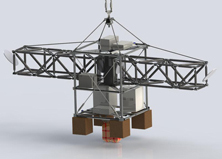
Flying on a high altitude balloon to 40,000 meters (130,000 feet), the Balloon Experimental Twin Telescope for Infrared Interferometer (BETTII) will provide access to the cosmos similar to that of an orbiting observatory. BETTII will explore a region of the electromagnetic spectrum, the far-infrared (FIR), using a technology called interferometry. Astronomers will gain a sharper, more detailed view of star formation, galaxy evolution, and the formation of planetary systems around other stars.
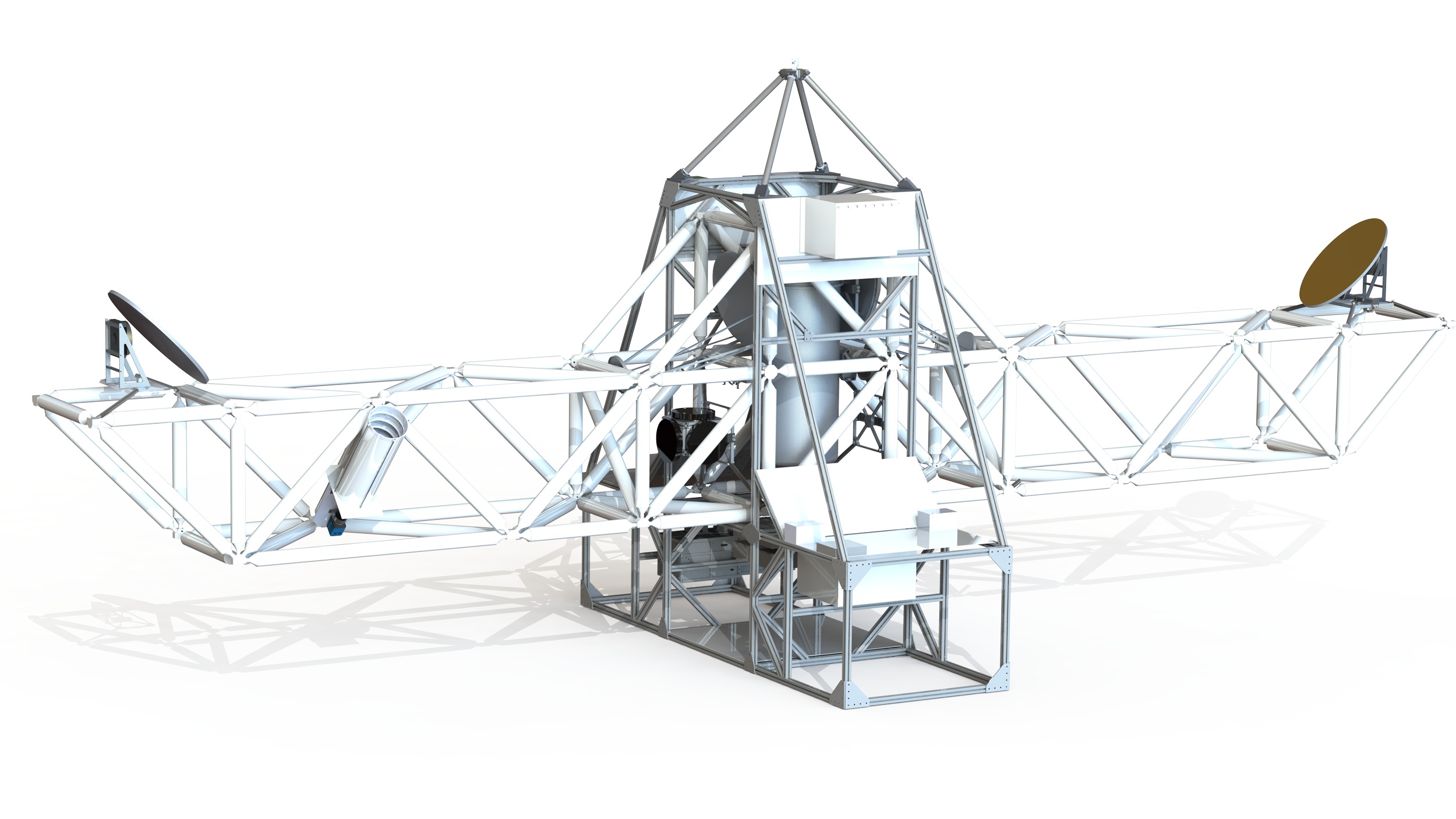
BETTII is an 8-meter boom interferometer to operate at wavelengths of 30-90 mm on a high-altitude balloon. The long baseline will provide unprecedented angular resolution (∼0.5") in this band, and the high atmospheric transmission at balloon altitudes will allow the unique double-Fourier instrument on BETTII to obtain spectral resolution up to R ≡ λ/Dλ ∼ 100. The combination of these capabilities will provide spatially resolved spectroscopy on astrophysically important sources, exploring the physical processes that lurk below the resolution limits of current FIR facilities.
The BETTII project is now four years old and has made significant progress toward completing the payload. The design of BETTII is complete, and all hardware is either in-hand or has been ordered. The exoskeleton is currently being used for testing of the gondola control system, including both sensors and control mechanisms, and all individual mechanisms have been carefully tested under flight-like conditions. Going forward, we are testing individual components of the system and beginning the instrument integration process. By the end of 2015, the entire BETTII payload will be complete, and then the team will focus on the system integration and tests needed to be ready for flight in fall 2016.
Data acquired with BETTII will be complimentary to observations with space observatories such as Herschel and the James Webb Space Telescope, exploring the FIR wavelength range with unprecedented high angular resolution. These data will be powerful tools for understanding star formation in clusters, and with future flights, for understanding active galactic nuclei and the late stages of stellar evolution.
The BETTII project is a collaboration between Goddard, the University of Maryland, Johns Hopkins University, Cardiff University, and University College London, with assistance from the Far-Infrared Telescope Experiment team in Japan.
BETTII is a first step toward the coming era of space-based infrared interferometry, enabling a technology that will transform astronomy and astrophysics. In addition, the project relies substantially on the talents of undergraduate interns and student workers, graduate students, and post-doctoral researchers. Involving young scientists and engineers with BETTII will develop the technical and leadership expertise required for success in future space-based interferometer missions.
 |
 |
 |
For people interested in the Universal Double-Fourier sensitivity calculator, the most up-to-date version can be found here. This tool was created by members of the BETTII team to help predict the spectral sensitivity of any space-based, double-Fourier mission, and explores various modifications to the traditional instrument (e.g. post-combination dispersive element). For any comments or questions, please contact Maxime Rizzo.
To learn more about the BETTII mission and, see the About BETTII page. To find out more about the research that will be done with the observatory, see the BETTII Science Goals page. Please also read about the important contributions that students are making to the BETTII project.